
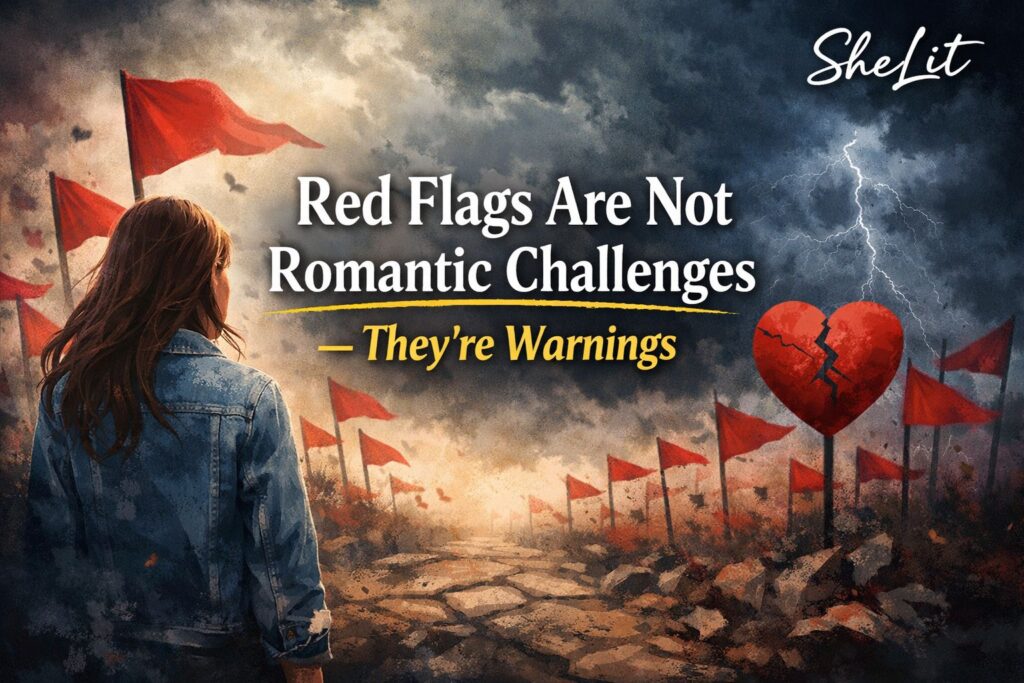
In movies, toxic love is often packaged as passion.
In reels, obsession is sold as intensity.
In real life, red flags are still dangerously misunderstood as “he will change,” “this is just how love is,” or worse “my love can fix him.”
But let’s be clear:
Red flags are not romantic challenges. They are warnings.
The Dangerous Glorification of Toxic Love
From Bollywood to global pop culture, women have been conditioned to romanticize suffering. We’re taught that:
- Jealousy means care
- Control means protection
- Anger means passion
- Emotional distance means mystery
This narrative quietly tells women that endurance is love and pain is proof of commitment. Over time, we start confusing emotional instability with depth and disrespect with desire.
But love was never meant to feel like fear, anxiety, or constant self-doubt.
What Red Flags Actually Look Like
Red flags are not always dramatic or loud. Often, they appear subtly:
- You feel the need to explain or justify their bad behavior to yourself or others
- Your boundaries are repeatedly ignored, mocked, or questioned
- You feel emotionally drained but still guilty for asking for bare minimum respect
- They dismiss your feelings as “overthinking” or “drama”
- You start shrinking yourself to keep the peace
These are not phases.
These are signals.
Why Women Are Told to Ignore Them
Women are socialized to be understanding, forgiving, and patient, often at the cost of their own well-being. We are praised for adjusting, compromising, and “holding relationships together,” even when it means tolerating emotional neglect or abuse.
Society rarely asks:
Why should love require so much suffering from one side?
Calling red flags “challenges” places the responsibility of fixing broken behavior on women instead of holding the person accountable.
Love Is Not a Rehabilitation Center
It is not your job to heal someone who refuses to heal themselves.
It is not empowerment to stay where you are disrespected.
It is not strength to endure harm in the name of loyalty.
Healthy love does not require you to lose yourself. It does not demand silence, fear, or emotional labor as proof of commitment.
Choosing Yourself Is Not Selfish
Walking away from red flags is not giving up, it is choosing safety, dignity, and self-respect. It is understanding that peace is more romantic than chaos, and consistency is more attractive than intensity.
At SheLit, we believe love should feel like support, not survival.
A Final Reminder
If something feels wrong, it probably is.
Your intuition is not overreacting, it is protecting you.
Red flags don’t turn green with love.
They turn into warnings we wish we had listened to earlier.