
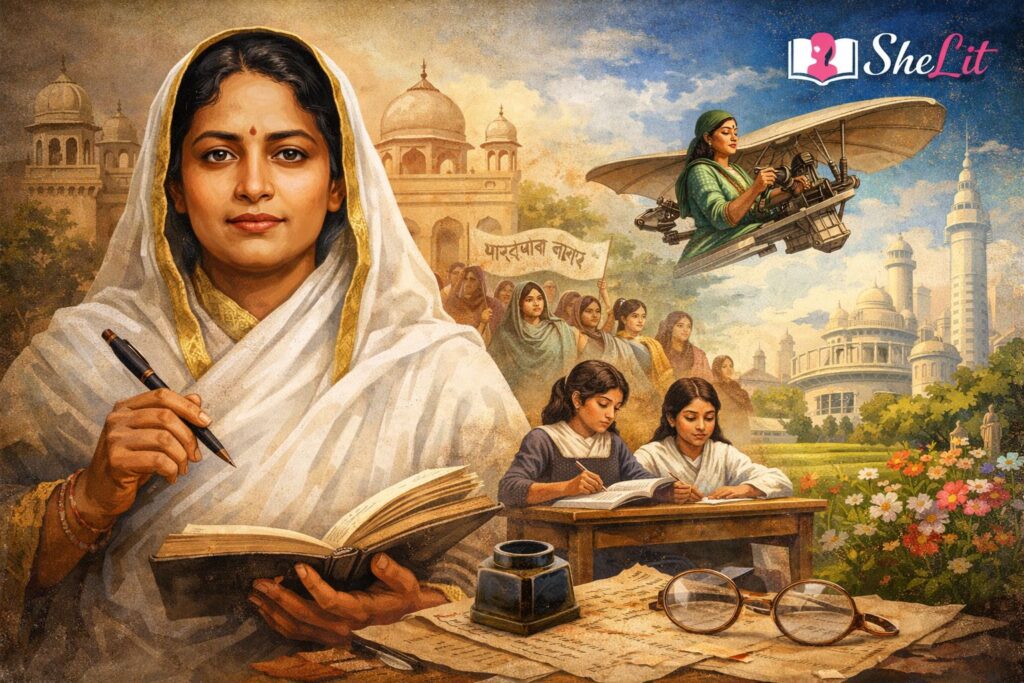
In the early 20th century, when women’s education was considered unnecessary and even “dangerous,” one Bengali woman stood up against the system with nothing but courage, intellect, and her pen. Begum Rokeya Sakhawat Hossain (1880–1932) was a writer, educator, and social reformer who became one of the strongest voices for women’s rights in South Asia.
Rokeya did not simply dream of change, she built it.
A Girl Raised Inside Restrictions
Begum Rokeya was born in Pairaband, Rangpur (present-day Bangladesh) in a conservative Muslim family. Like many girls of her time, she was expected to remain inside the home, follow purdah, and live quietly. Education for girls was discouraged, and Bengali language learning was often seen as “inappropriate” for women in elite families.
But Rokeya was not meant to be silent.
With the help of her brother and sister-in-law, she secretly learned Bengali and English. Even this small act was a rebellion, because it challenged the idea that women should not think, question, or grow intellectually.
A Pen That Challenged Patriarchy
Begum Rokeya used writing as her strongest weapon. Her essays and stories were bold, sharp, and fearless. She questioned patriarchy, exposed the hypocrisy of society, and demanded equal rights for women, especially the right to education.
Her most famous work, Sultana’s Dream (1905), is considered one of the earliest feminist science-fiction stories in the world. In this story, Rokeya imagines a society where women lead the country through science, education, and peace, while men remain confined indoors.
Through satire, she delivered a powerful message:
If women are called weak, why does society become better when they lead?
Education Was Her Revolution
Rokeya believed that without education, women could never become free. She often argued that society kept women uneducated intentionally because educated women would not accept injustice.
After the death of her husband, who supported her vision, she dedicated her life fully to women’s education.
In 1916, she established the Sakhawat Memorial Girls’ School in Kolkata, one of the first institutions for Muslim girls in Bengal. At that time, convincing families to send their daughters to school was extremely difficult. Parents feared social judgement and believed education would make girls “too modern.”
But Rokeya persisted.
She visited homes, spoke to families, and encouraged them to educate their daughters. Her school was not just a building , it was a breakthrough in a society that tried to keep women behind walls.
A Feminist Far Ahead of Her Time
Begum Rokeya’s feminism was not limited to slogans. It was rooted in real-life struggles. She wrote about the everyday oppression women faced like forced marriages, lack of freedom, denial of education, and restrictions on mobility.
She strongly criticized the mindset that treated women as intellectually inferior. Her writing showed that women were not naturally weak, they were made weak by social systems that denied them opportunity.
She believed women deserved:
- equal education
- dignity and respect
- financial independence
- freedom of thought
- a voice in society
Why Begum Rokeya Still Matters
Even today, Begum Rokeya’s story feels relevant. Across South Asia, many girls still struggle for basic rights like education, safety, and independence. Patriarchy still fears women who think freely.
Rokeya’s life reminds us that progress is never gifted. It is built through courage.
She didn’t wait for permission.
She created her own path and opened it for thousands of others.
Begum Rokeya was not just a writer or a reformer. She was a movement. She proved that the strongest revolutions do not always happen on streets but sometimes, they happen through books, classrooms, and ideas that refuse to die.
Her message remains timeless:
Educate a woman, and you educate a nation.
And in the spirit of SheLit, her legacy deserves to be remembered as one of the earliest and most powerful voices of women’s empowerment in the subcontinent.