
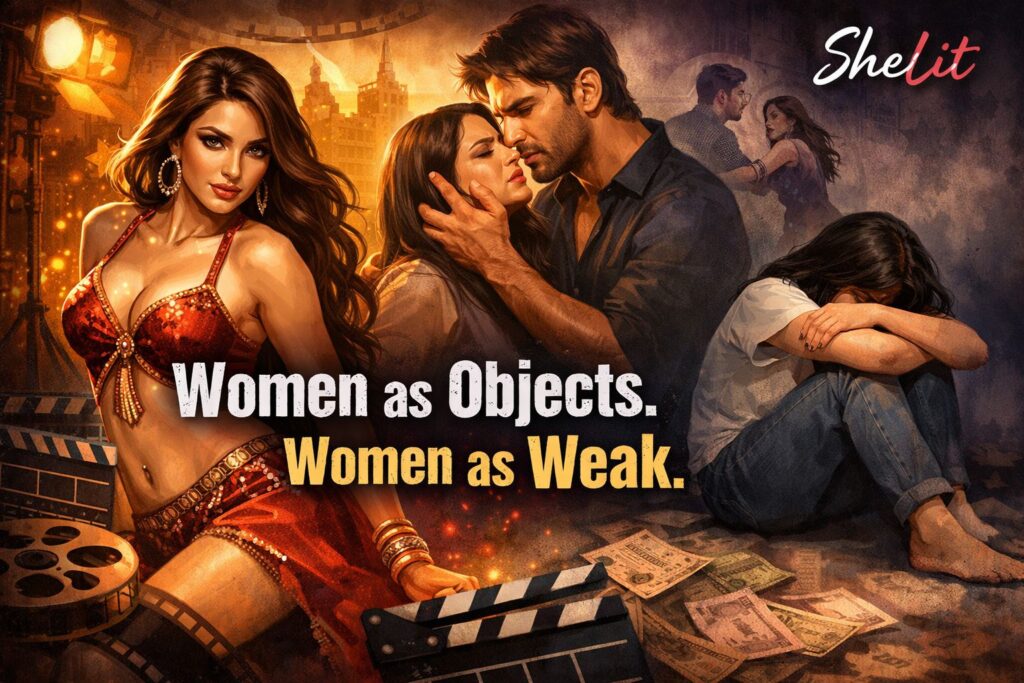
Cinema is one of the most powerful tools of influence in India. Bollywood films are not just a source of entertainment; they shape emotions, attitudes, aspirations, and social norms. What we repeatedly watch on screen slowly becomes acceptable in real life. Unfortunately, for decades, mainstream Bollywood has contributed to portraying women as weak, dependent, submissive, and often reduced to objects of glamour rather than respected as equal individuals.
While there are some progressive films, the dominant narrative has done more harm than good to the image of women in Indian society.
Women Reduced to Objects of Glamour
One of the most visible problems in Bollywood is the objectification of women, especially through songs and dance sequences. Women are frequently shown as decorative elements whose primary role is to entertain the male gaze.
Popular item numbers such as:
- “Munni Badnaam Hui” (Dabangg)
- “Sheila Ki Jawani” (Tees Maar Khan)
- “Fevicol Se” (Dabangg 2)
focus excessively on body movements, physical appearance, and sexualized lyrics. The camera often highlights specific body parts, turning women into visual commodities rather than characters with emotions or purpose.
These songs are marketed as “fun” or “mass entertainment,” but they send a clear message: a woman’s value lies in her body, not her intellect or individuality.
The Normalization of Weak and Dependent Female Characters
In many Bollywood films, women are portrayed as emotionally weak and dependent on men for protection, validation, and identity. The male lead is shown as strong, dominant, and decisive, while the female lead often exists only to support his journey.
Films like Kabir Singh present a deeply problematic narrative. The male protagonist is aggressive, controlling, and abusive, yet the woman remains silent, forgiving, and submissive. The film romanticizes toxic behavior and portrays the woman’s suffering as proof of love.
Such portrayals normalize the idea that:
- Male aggression is acceptable
- Female silence is ideal
- Endurance is a woman’s virtue
This weakens the social understanding of healthy relationships.
Glorifying Stalking and Harassment as Romance
Another dangerous trend in Bollywood is the romanticization of stalking and harassment. Many films show the male hero persistently following, teasing, or harassing a woman until she eventually “falls in love.”
Movies like Raanjhanaa and several older romantic films portray obsessive behavior as passion. The woman’s repeated rejection is shown as a temporary obstacle rather than a clear expression of choice.
This creates a harmful mindset in society:
- “No” is seen as encouragement
- Consent is ignored
- Persistence is rewarded
Such narratives blur the line between love and harassment, contributing to real-life crimes against women.
Women as Sacrificial Figures
Bollywood often glorifies the idea that a “good woman” is one who sacrifices her dreams, ambitions, and identity for love or family. Even educated and modern female characters are shown giving up careers once they fall in love or get married.
If a woman prioritizes her ambition, she is portrayed as:
- Selfish
- Cold-hearted
- Emotionally incomplete
This reinforces the belief that a woman’s ultimate purpose is marriage and adjustment, not self-realization.
Male-Centric Storytelling and Female Silence
In most mainstream films, the story revolves around the male hero. Women exist as:
- Love interests
- Emotional support
- Plot devices
Their struggles are rarely explored independently. Even when women suffer violence or injustice, the narrative often shifts to how it affects the male protagonist, not the woman herself.
This constant sidelining teaches society that women’s experiences matter less.
The Psychological Impact on Society
Repeated exposure to such portrayals has serious consequences:
- Young girls internalize insecurity and self-doubt
- Young boys develop entitlement and dominance
- Objectification becomes socially acceptable
- Patriarchal norms are reinforced
Cinema does not just reflect society, it actively shapes it.
Positive Examples: Proof That Change Is Possible
It is important to acknowledge that Bollywood has also produced meaningful films that challenge stereotypes, such as:
- Pink – emphasizing consent and women’s agency
- Queen – showcasing self-discovery and independence
- Thappad – questioning normalized domestic violence
- Kahaani – presenting a strong, intelligent female lead
- Dangal – celebrating women’s strength and ambition
These films prove that audiences are ready for responsible storytelling.
For decades, Bollywood has contributed to weakening the image of women by portraying them as objects of glamour, symbols of sacrifice, or silent sufferers. Such representations shape social attitudes and normalize inequality.
Women are not weak.
Women are not objects.
Women are not secondary characters in society.
If cinema has the power to influence minds, it also has the responsibility to do better. True progress will come when women are portrayed as complete human beings with strength, flaws, ambition, and choice.
It is time Bollywood chooses responsibility over convenience and dignity over spectacle.