
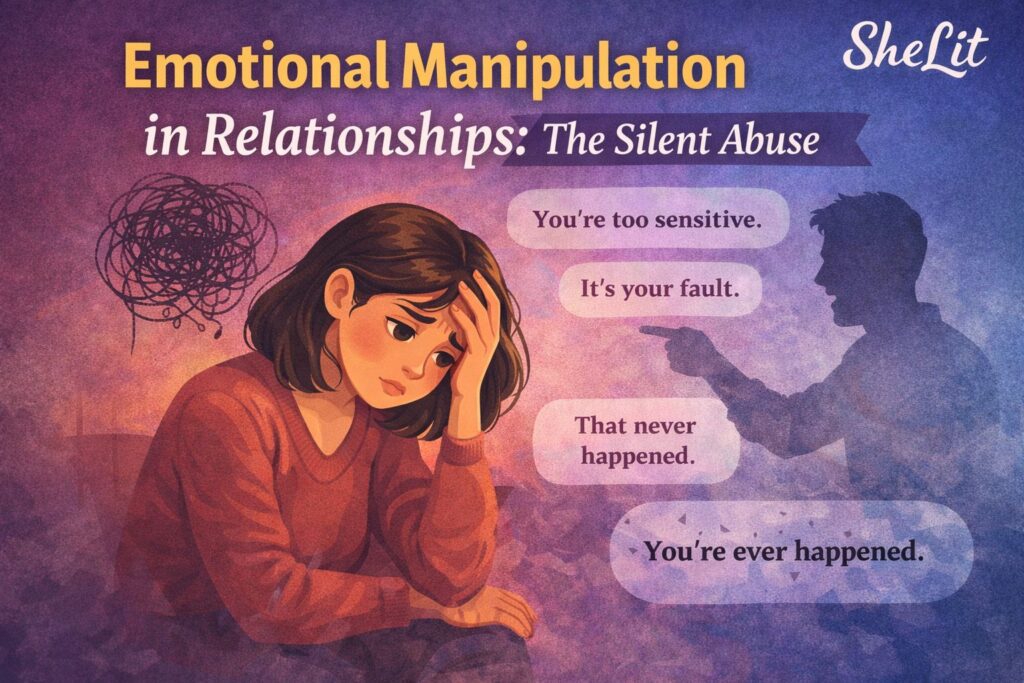
When love starts feeling like confusion, guilt, and emotional exhaustion.
Sometimes, a relationship doesn’t hurt you loudly. It confuses you quietly.
You’re not being shouted at. You’re not being hit.
But you constantly feel:
- Drained
- Guilty
- Overthinking everything
And the most dangerous part? You start believing it’s your fault.
This is what emotional manipulation in relationships looks like a form of silent abuse that slowly affects your confidence, your peace, and your identity.
What is Emotional Manipulation?
Emotional manipulation is when someone controls your feelings or reactions in a way that benefits them, often without taking responsibility for the harm they cause.
It doesn’t look aggressive. It looks subtle.
It sounds like:
- “You’re overreacting.”
- “I didn’t mean it like that.”
- “You always create issues.”
Over time, these words make you question yourself more than you question them.
Why It’s Hard to Recognize
One of the biggest reasons emotional manipulation goes unnoticed is because it is not constant.
There are good moments. There is care, attention, even love, And that makes you stay.
You hold on to the version of them that felt right in the beginning. You convince yourself that things will improve. You adjust, you explain, you try harder.
But deep down, something always feels off, And that feeling matters.
Common Signs of Emotional Manipulation
- You start doubting yourself (Gaslighting)
You clearly remember something, but they deny it.
Slowly, you begin to question your own memory and perception.
- You feel guilty for expressing yourself
Every time you try to communicate your feelings, it turns into an argument where you feel like the problem.
- Love feels conditional
They are warm when you behave a certain way and distant when you don’t.
You start adjusting yourself just to keep things “normal.”
- You are always the one apologizing
Even when you are hurt, you end up saying sorry just to avoid conflict.
- You feel emotionally tired all the time
The relationship feels more exhausting than comforting.
What It Does to You
Emotional manipulation doesn’t break you instantly, it changes you slowly.
You start:
- Overthinking every conversation
- Losing confidence in your own decisions
- Walking on eggshells
- Prioritizing their emotions over yours
And somewhere in between all this, you begin to lose yourself.
Why Many Women Stay
Leaving isn’t always easy.
You stay because:
- You love them
- You remember the good moments
- You hope they will change
- You don’t want to start over
But sometimes, staying comes at the cost of your peace.
The Truth About Healthy Love
Love should not feel like:
- Confusion
- Fear
- Constant anxiety
Healthy love feels like:
- Stability
- Respect
- Emotional safety
You should not have to shrink yourself to keep someone.
How to Start Protecting Yourself
You don’t need a big step. Start small.
- Trust your feelings when something feels wrong
- Stop over-justifying repeated behavior
- Express yourself without guilt
- Talk to someone you trust
And most importantly: don’t ignore your own voice.
Final Thought
You are not “too sensitive.” You are not “overthinking.”
You are reacting to something that is affecting you.
Emotional manipulation may be silent, but your feelings are not, And you deserve a love where you feel secure, respected, and fully yourself.
SheLit Note
Awareness is power, And sometimes, recognizing the problem is the first step toward choosing yourself.