
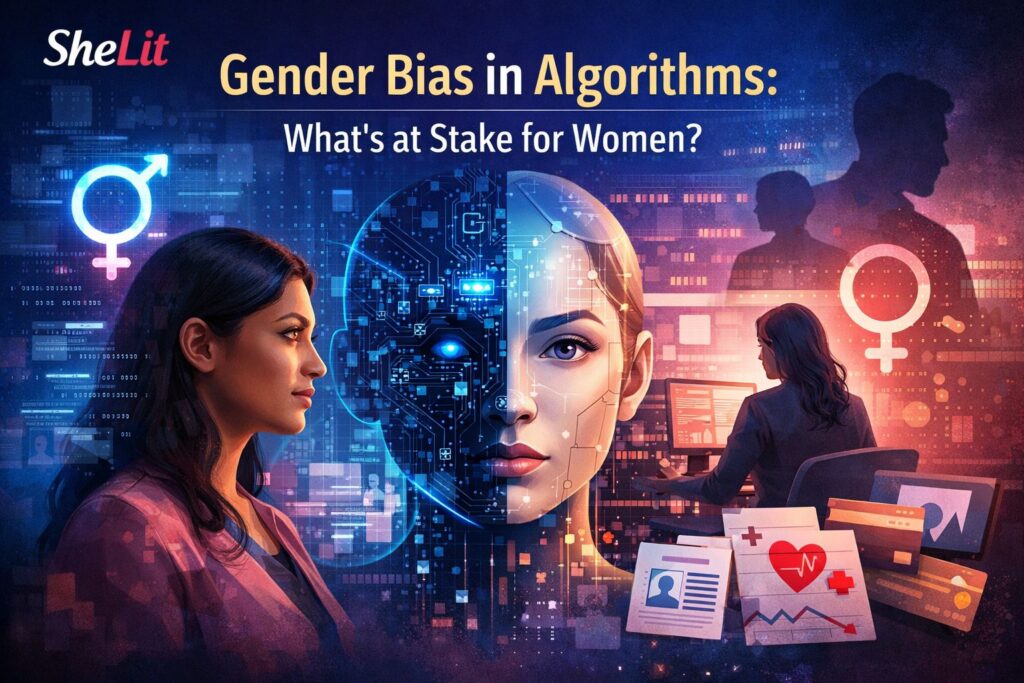
Introduction: When Technology Isn’t Neutral
Artificial Intelligence and algorithms are often presented as objective, rational, and unbiased. We are told that machines don’t discriminate, people do. But reality tells a different story.
From job hiring and healthcare to social media and finance, algorithms increasingly decide who gets opportunities and who doesn’t. And when these systems inherit society’s biases, women often pay the price.
Gender bias in algorithms is not a futuristic concern, it is a present-day inequality hidden behind technology.
Understanding Gender Bias in Algorithms
Algorithms are sets of rules trained on data to make decisions or predictions. Gender bias occurs when these systems produce outcomes that systematically disadvantage women, not because of merit or ability, but due to:
- Biased historical data
- Gender stereotypes embedded in datasets
- Male-dominated tech design teams
- Oversimplified assumptions about gender
In simple terms: algorithms learn from the past, and the past has not been equal for women.
How Gender Bias Enters the System
- Biased Data
Most AI systems are trained on historical data. If women were underpaid, under-hired, or under-represented in the past, algorithms treat that inequality as “normal.”
An algorithm cannot distinguish discrimination from data unless humans teach it to.
- Lack of Women in Tech Development
Globally, women are underrepresented in AI and tech leadership roles. When design teams lack diversity, critical gender-specific concerns are often overlooked.
- Gender Stereotypes in Design
Certain traits like assertiveness, leadership, technical competence are unconsciously coded as “male,” while caregiving roles are coded as “female,” reinforcing stereotypes.
Real-World Impact on Women
- Hiring & Career Growth
AI-based recruitment tools can:
- Penalize career breaks (often taken by women for caregiving)
- Prefer male-dominated career patterns
- Downgrade resumes with women-associated words or experiences
Result: Qualified women are filtered out before a human ever sees their profile.
- Healthcare Inequality
Many medical algorithms are trained primarily on male data. This leads to:
- Misdiagnosis of women’s symptoms
- Delayed treatment for heart disease, autoimmune disorders, and mental health issues
- Inaccurate risk assessments
Result: Women receive poorer quality healthcare despite greater health needs.
- Facial & Voice Recognition
Early AI systems showed higher error rates for:
- Women
- Dark-skinned women
- Non-Western facial features
Result: Increased risk of surveillance errors, exclusion, and digital invisibility.
- Financial & Credit Systems
Algorithmic credit scoring often ignores:
- Unpaid care work
- Informal employment
- Career interruptions
Result: Women are often labeled “high-risk borrowers” despite financial responsibility.
- Digital Advertising & Content
Algorithms may show:
- High-paying job ads more to men
- Beauty or domestic content more to women
Result: Reinforcement of occupational and social gender roles.
Why This Matters for Gender Equality
When biased algorithms scale, discrimination becomes automated. Unlike individual bias, algorithmic bias:
- Affects millions at once
- Operates invisibly
- Is difficult to challenge or appeal
This means inequality is no longer just social, it is systemic, coded, and scalable.
What Can Be Done?
- Inclusive & Balanced Data
Data must represent women across:
- Age
- Class
- Caste
- Geography
- Life experiences
- Gender-Diverse Tech Teams
More women must be involved in:
- AI design
- Data science
- Policy decision-making
Representation shapes outcomes.
- Algorithm Audits & Accountability
Companies and governments must:
- Conduct gender impact assessments
- Regularly audit algorithms for bias
- Allow independent scrutiny
- Explainable & Transparent AI
Women deserve to know:
- Why a decision was made
- What factors influenced it
- How to challenge unfair outcomes
- Feminist Technology Ethics
Technology should be built with:
- Equity
- Care
- Human dignity
- Social responsibility
AI must serve society not reinforce its injustices.
A Feminist Question for the Digital Age
The question is not whether algorithms can be biased.
The real question is:
Do we have the courage to redesign technology so it works for women, not against them?
Gender-just technology is not optional, it is essential for a fair future.
If women are excluded from digital systems today, inequality will be coded into tomorrow.
At SheLit, we believe that conversations about women’s empowerment must include technology because the future is digital, and women deserve an equal place in it.