
Useful for teens and parents
When we talk about child safety in India, one law stands out as a strong shield for children: The POCSO Act.
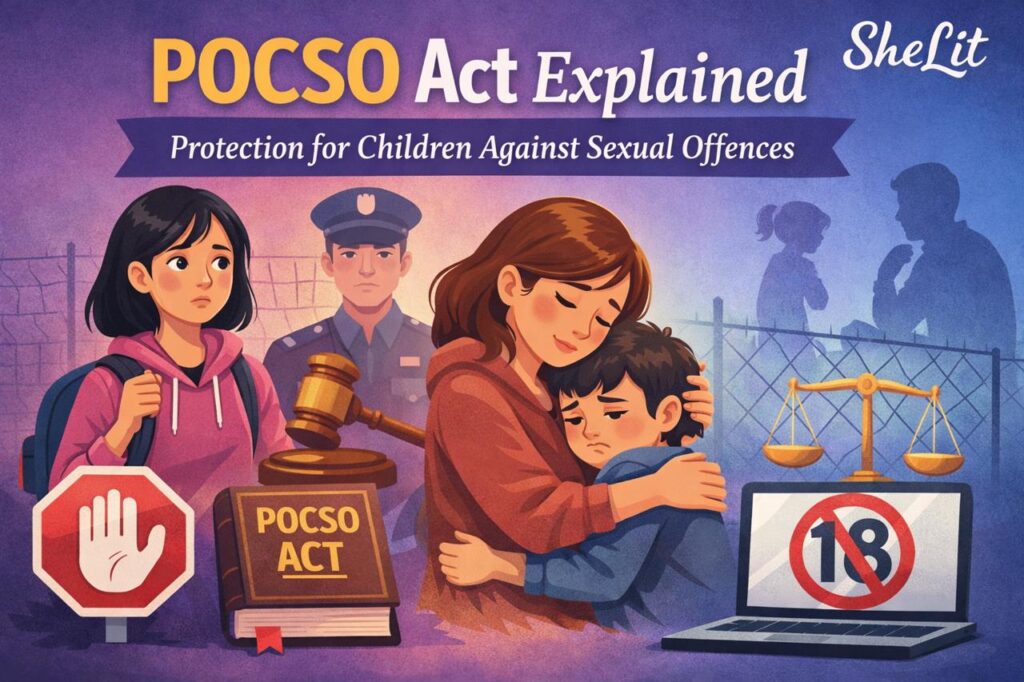
The Protection of Children from Sexual Offences (POCSO) Act, 2012 was made to protect children from sexual abuse, harassment, and exploitation. Many people have heard the name but don’t know what it actually means, what counts as an offence, and what to do if something happens.
This article explains the POCSO Act in a simple way for teenagers, parents, teachers, and every responsible citizen.
What is the POCSO Act?
The POCSO Act is a special law in India that protects children below 18 years of age from:
- Sexual assault
- Sexual harassment
- Pornography
- Sexual abuse in any form
It also provides a child-friendly legal process so that children are not traumatized again during reporting and court procedures.
Who is considered a child under POCSO?
Under the POCSO Act, a child means anyone below 18 years.
Even if the child is 17 years and 11 months old, the Act still applies.
Why was the POCSO Act needed?
Earlier, India did not have a specific law focused only on child sexual offences. Cases were often handled under general sections of IPC, which didn’t cover everything properly.
POCSO was created because:
- Child abuse cases were rising
- Children needed a safer, faster justice system
- Reporting was difficult due to fear and stigma
- The legal system needed child-sensitive rules
What offences does POCSO cover?
POCSO covers a wide range of crimes. Let’s understand them in simple terms:
- Sexual Assault
This includes any unwanted sexual touch.
For example:
- Touching a child’s private parts
- Making the child touch someone else’s private parts
- Any sexual act without penetration
- Penetrative Sexual Assault
This is a more serious offence and includes penetration, including:
- Penetration of vagina, mouth, urethra, or anus
- Inserting objects
- Any forced sexual penetration
This is one of the most strictly punished crimes under POCSO.
- Sexual Harassment
Sexual harassment includes actions like:
- Showing pornography to a child
- Making sexual comments
- Sexual gestures
- Stalking a child
- Repeated unwanted sexual behaviour
- Using a Child for Pornography
If someone:
- Makes a child appear in porn videos
- Stores, shares, sells child sexual content
- Forces a child to pose in sexual ways
it is punishable under POCSO.
What is “Aggravated” sexual assault?
Some offences are considered even more serious. These are called Aggravated offences, for example when:
- The offender is a family member
- The offender is a teacher, doctor, police officer, or guardian
- The child is under 12 years
- The child is mentally or physically disabled
- The offence is repeated
- The child is harmed severely
These cases carry heavier punishments.
What makes POCSO different from other laws?
POCSO is powerful because it is designed to protect the child in every step.
✅ Child-friendly reporting
- The child should not be forced to repeat the story again and again
- The child can give a statement in a safe environment
- The child is not treated like an accused
✅ Special Courts
POCSO cases are handled in Special Courts, meant to be faster and sensitive.
✅ Identity of child is protected
Media and public are not allowed to reveal the child’s identity.
✅ Punishment is strict
POCSO has strict punishments and zero tolerance.
Important Point: Consent does NOT matter under POCSO
Under POCSO:
Any sexual activity with a person below 18 is considered an offence.
Even if:
- The child “agreed”
- It was a relationship
- It was “mutual”
Legally, a minor cannot give valid consent.
This is why teens must understand the seriousness of the law.
Who can report a POCSO case?
Under the Act, anyone can report, including:
- Parents
- Friends
- Teachers
- Neighbours
- Relatives
- Doctors
- The child themselves
Mandatory Reporting: A key rule
POCSO makes it compulsory to report child sexual abuse.
This means:
If a teacher, doctor, or any adult knows a child is being abused and they do not report, they can also be punished.
How to report a POCSO case?
If you suspect or know a child is being abused:
Step 1: Call 1098 (Childline)
This is India’s child helpline.
Step 2: Go to the nearest police station
You can file an FIR. The police must register it.
Step 3: Seek medical help immediately
Medical examination should be done with sensitivity and in presence of a trusted person.
What should parents do if a child tells them something?
If a child opens up about abuse, the first reaction matters a lot.
✅ Do:
- Stay calm
- Believe the child
- Tell them “It’s not your fault”
- Thank them for sharing
- Report the matter immediately
- Get professional counselling if needed
❌ Don’t:
- Scold the child
- Blame them
- Say “Why didn’t you tell earlier?”
- Ask too many questions like an investigation
- Threaten the abuser on your own
What should teens know about safety?
If you are a teenager, remember:
- Your body is yours
- Nobody has the right to touch you in a way that makes you uncomfortable
- Even if the person is “known” (relative, teacher, family friend), it still counts
- You can say NO
- You can ask for help
- Reporting is not shameful, abuse is shameful
A big truth: Most abusers are known to the child
Many people think abuse happens only by strangers.
But in reality, in many cases the offender is:
- A relative
- A neighbour
- A family friend
- A teacher
- Someone trusted
This is why children must be taught about safe and unsafe touch early.
Punishment under POCSO (simple overview)
Punishments vary depending on the offence, but they can include:
- Imprisonment
- Heavy fines
- Long-term jail for aggravated cases
- In some extreme cases, even life imprisonment
The law is strict because the crime is serious.
Final Message: POCSO is protection, not fear
POCSO is not meant to scare children.
It is meant to:
- Protect them
- Give them justice
- Stop abusers
- Create a safer society
Child safety is not just a family issue, it’s a society issue.
If you or someone you know needs help
📌 Childline: 1098
📌 Contact local police or women/child protection authorities.
At SheLit, we believe awareness is protection.
Talking about child safety is not “too sensitive”, it is necessary.
Because silence protects the abuser, not the child.